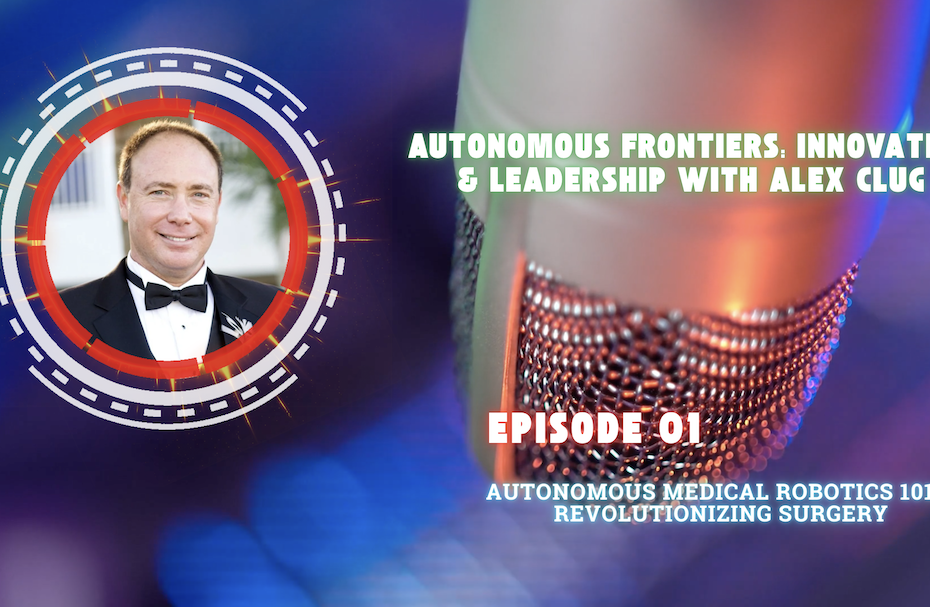
Welcome to the launch of Autonomous Frontiers: Innovation & Leadership with Alex Clug. In this first episode, “Autonomous Medical Robotics 101 – Revolutionizing Surgery,” Alex explores how autonomous surgical robots are reshaping healthcare. From early robotic-assisted systems to cutting-edge AI-powered breakthroughs, this episode unpacks the present and future of surgical robotics in a way that’s clear, engaging, and accessible for professionals, students, and curious listeners alike.
Watch the full episode below to dive deeper into this groundbreaking discussion.
What This Episode Covers
1. From Robotic-Assisted to Autonomous Surgery
Alex begins by tracing the evolution from robotic-assisted platforms like the Da Vinci system to true autonomy. Unlike earlier robots, which act as extensions of the surgeon’s hands, autonomous systems can perform specific surgical steps independently—such as cutting bone or suturing tissue—based on pre-programmed plans and AI guidance.
2. How Autonomous Surgical Robots Work
The episode explains the four pillars behind surgical autonomy:
- Robotic Hardware – Tremor-free precision instruments with micro-movement capability.
- Imaging & Sensing – 3D visualization, CT scans, and motion tracking to adapt to moving organs.
- AI & Software – Algorithms that plan incisions, recognize anatomy, and adjust mid-surgery.
- Surgeon Oversight – Human experts remain in control, supervising like a pilot over autopilot.
3. Breakthrough Case Studies
Listeners hear about milestone projects and real-world adoption:
- Johns Hopkins’ STAR Robot – Successfully performed autonomous intestinal suturing, surpassing expert surgeons in accuracy.
- Orthopedic Robots – Used in knee and hip replacements, cutting bone with sub-millimeter accuracy.
- SS Innovations (India) – Bringing affordable surgical robotics to underserved regions, including performing telesurgeries across 1,200 miles.
4. Benefits for Patients and Surgeons
The discussion highlights how autonomy enhances outcomes and workflows:
- Greater precision and consistency across procedures.
- Lower complication rates in delicate surgeries.
- Faster recovery thanks to minimally invasive methods.
- Reduced surgeon fatigue through task delegation.
- Expanded global access to advanced surgeries once limited to elite hospitals.
5. The Future of Surgical Robotics
Alex closes the episode by looking ahead at what’s possible:
- Fully autonomous routine procedures like appendectomies.
- Telesurgery across continents—and even in space exploration.
- Integration with AR, micro-robots, and real-time imaging.
- Democratization of high-quality surgery for patients worldwide, regardless of geography.
Key Takeaways
- Autonomous surgical robots mark the next leap in medical technology, moving from passive tools to active partners in surgery.
- Combining robotics, AI, and surgeon supervision, these systems deliver safer, more precise, and more consistent results.
- Real-world examples—from orthopedic implants to cardiac telesurgeries—prove that this revolution is already underway.
- The future holds even greater potential for expanding access, reducing errors, and reshaping how healthcare is delivered globally.
In Conclusion
Episode one of Autonomous Frontiers: Innovation & Leadership with Alex Clug makes one point clear: the fusion of robotics and AI is not a distant dream—it’s transforming operating rooms today. By partnering with surgeons, autonomous systems bring unmatched precision, consistency, and accessibility to patients everywhere.
Watch the full episode above and subscribe to follow upcoming conversations on ethics, leadership, and the next wave of innovation in medicine and beyond.

Alex Clug is a global entrepreneur and investor with 25+ years building and scaling ventures in medical robotics, telecommunications, mining, and private equity. He currently leads The Dolphin Group, advising early-stage and cross-border companies in robotics, fintech, natural resources, and other innovation-driven industries.