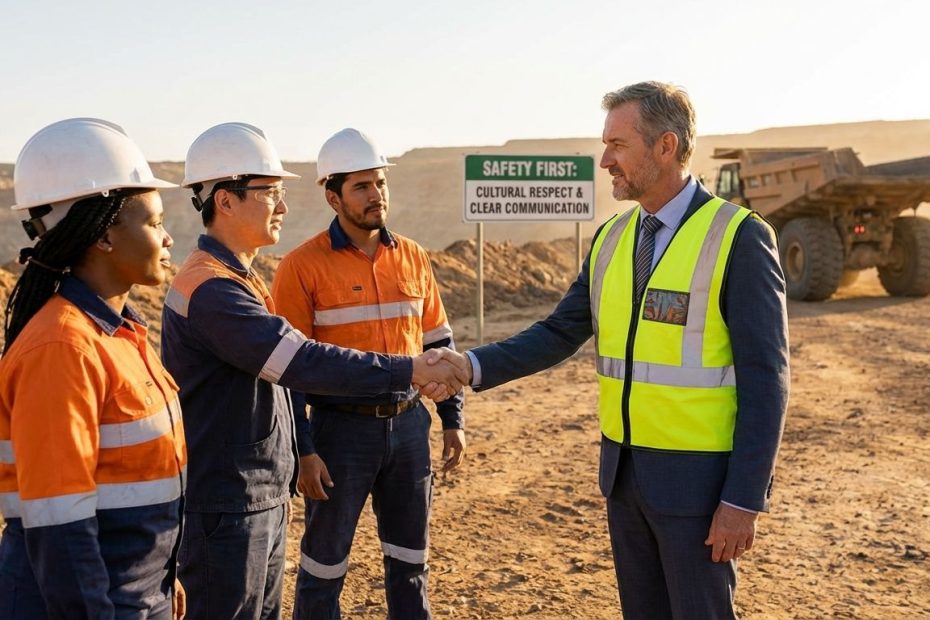
To succeed as a cross-continental Chief Executive Officer (CEO), you manage cultural intelligence in global mining operations by aligning leadership style, decision processes, and stakeholder engagement with the cultural realities of each region you operate in.
You oversee assets that span continents, regulatory systems, languages, and community expectations. Your technical competence keeps the ore moving; your cultural intelligence keeps the business stable. What follows equips you with field-tested strategies, executive decision patterns, and measurable practices to lead mining operations across borders without losing cohesion, credibility, or performance.
What Is Cultural Intelligence in Global Mining Operations?
Cultural intelligence in global mining operations is your ability to understand, interpret, and adapt to diverse cultural norms while maintaining operational consistency and corporate governance standards. It is not a soft skill add-on; it is an operational risk-control mechanism.
Mining is inherently global. According to the World Mining Data 2025 report published by the Austrian Federal Ministry of Finance, over 17.9 billion metric tons of mineral raw materials were extracted worldwide in the most recent reporting year. The largest producing regions include China, Australia, the United States, Russia, and Brazil, each operating under distinct labor cultures, regulatory structures, and community expectations. When your operations span multiple of these jurisdictions, leadership uniformity without cultural adaptation becomes a liability.
In practice, cultural intelligence means you adjust how you negotiate land access in Latin America, how you conduct safety briefings in West Africa, and how you approach workforce incentives in Australia. You lead with consistency in safety, compliance, and production standards, but you adapt how those standards are communicated and embedded locally.
Why Does Cultural Intelligence Matter More in Mining Than in Other Industries?
Cultural intelligence carries amplified weight in mining because your operations are physically embedded in local communities and often operate for decades.
Unlike technology firms that can relocate easily, a mining site commits capital for 20–40 years. The International Council on Mining and Metals (ICMM) reports that social license to operate is now cited as one of the top three strategic risks in global mining board surveys. Community opposition, labor unrest, and local political friction have halted multi-billion-dollar projects in Peru, Chile, and parts of Africa in recent years.
Your production targets mean little if a community blockade stops transport routes or if workforce morale deteriorates due to cultural misunderstandings. Cultural intelligence enables you to interpret early warning signals. You recognize when silence in a meeting indicates disagreement rather than agreement. You understand when a public criticism from a community leader reflects deeper frustration rather than a negotiating tactic.
In mining, misreading cultural cues affects capital allocation, project timelines, and investor confidence. That is why cultural intelligence sits alongside geological modeling and cost management as a board-level capability.
What Cultural Barriers Commonly Disrupt Global Mining Operations?
Cultural barriers in mining most often arise around hierarchy, communication styles, time orientation, and risk perception.
Hierarchy differences can destabilize management flow. In certain regions, questioning a senior manager publicly is viewed as disrespectful. In others, open debate signals engagement. If you apply a single leadership model across all sites, you unintentionally suppress input in some cultures and create friction in others. That leads to delayed reporting of safety incidents or under-communication of operational risks.
Communication styles also vary. Direct cultures expect explicit instructions. Indirect cultures rely on implied meaning and relational cues. In safety-critical environments, ambiguity increases risk. If a supervisor hesitates to clarify an unclear instruction because of cultural norms, you face preventable accidents. The International Labour Organization continues to report mining as one of the higher-risk sectors for workplace injury globally, reinforcing that communication clarity is not optional.
Time orientation adds another layer. Some cultures prioritize relationship-building before execution. Others prioritize immediate output. If you push execution without relationship alignment in relationship-oriented cultures, cooperation declines. If you allow excessive consultation in output-driven cultures, productivity suffers. Cultural intelligence enables you to calibrate pace without compromising standards.
How Do You Align Corporate Governance With Local Cultural Expectations?
You align corporate governance with local realities by separating non-negotiables from adaptable practices.
Your non-negotiables include safety standards, environmental compliance, anti-corruption policies, and reporting transparency. These align with global frameworks such as the Organisation for Economic Co-operation and Development (OECD) Due Diligence Guidance for Responsible Supply Chains and the ICMM Mining Principles. These standards remain consistent across sites.
What adapts is implementation style. In some regions, town hall meetings drive engagement. In others, informal discussions with community elders produce more meaningful alignment. Your governance structure must allow local leaders to design culturally appropriate engagement processes while meeting corporate requirements.
You also build cross-continental advisory councils that include regional leaders. This ensures your headquarters strategy reflects operational realities. When headquarters dictates policy without regional consultation, cultural friction intensifies. When regional input shapes governance adaptation, execution strengthens.
How Does Cultural Intelligence Strengthen Social License to Operate?
Your social license to operate depends less on contracts and more on trust.
According to research published by the University of Queensland’s Sustainable Minerals Institute, community trust strongly correlates with long-term operational stability in mining regions. Trust emerges when local populations believe leadership understands and respects their values.
Cultural intelligence shapes how you structure community benefit agreements. In some regions, infrastructure investment carries more value than direct financial compensation. In others, employment guarantees and local procurement commitments matter more. You evaluate community priorities before allocating resources.
When you demonstrate consistent engagement, local stakeholders view your company as a long-term partner rather than an extractive outsider. That perception reduces the probability of protests, legal disputes, and permit delays. Cultural intelligence turns stakeholder engagement from a reactive exercise into a strategic asset.
What Leadership Behaviors Build Cultural Intelligence Across Your Executive Team?
Cultural intelligence spreads when you institutionalize it.
You implement structured international rotations for senior managers. Exposure to different operational cultures accelerates adaptive leadership. Executives who have managed sites in multiple continents make fewer culturally tone-deaf decisions.
You invest in measurable Cultural Quotient (CQ) assessments. Academic research from the Cultural Intelligence Center demonstrates that cultural intelligence can be measured across cognitive, motivational, and behavioral dimensions. When you track these metrics alongside performance Key Performance Indicator (KPIs), you send a signal that cross-cultural competence matters as much as production efficiency.
You also require structured debriefs after major cross-border initiatives. What communication barriers emerged? Where did assumptions fail? What cultural adaptations improved outcomes? Institutional learning converts isolated experiences into scalable knowledge.
How Do You Measure the Return on Investment (ROI) of Cultural Intelligence in Mining?
You measure ROI through operational stability, employee engagement, and stakeholder risk reduction.
Employee turnover rates provide one indicator. In remote mining operations, replacement costs for skilled engineers and geologists remain high. When leadership misalignment increases dissatisfaction, turnover rises. Gallup’s 2025 global workplace study indicates that engaged teams outperform disengaged teams in productivity and safety outcomes. Cultural intelligence strengthens engagement in multicultural workforces.
You also track project delays linked to community disputes. Each month of delay on a large-scale copper or lithium project can cost millions in lost revenue. If improved stakeholder engagement reduces disruptions, that financial gain reflects the ROI of cultural intelligence.
Safety performance offers another measurable dimension. Clear cross-cultural communication reduces misinterpretation of safety protocols. Improvements in lost-time injury frequency rates across culturally diverse sites often correlate with stronger leadership alignment.
How Do You Manage Cross-Continental Communication at Scale?
You manage cross-continental communication by structuring clarity into every channel.
You standardize reporting templates while allowing local commentary sections that capture cultural or regional nuances. This preserves data consistency while acknowledging local conditions. Digital platforms enable real-time data sharing, but clarity depends on language precision.
You also train leaders to communicate with intentional simplicity. Complex phrasing increases misinterpretation across languages. Direct, structured communication improves comprehension. When meetings involve multiple regions, you confirm alignment through written summaries rather than verbal agreement alone.
Time zone management matters as well. If one region consistently absorbs late-night calls, resentment builds. Rotational scheduling reinforces fairness and demonstrates respect. Small adjustments signal cultural sensitivity and strengthen cross-continental cohesion.
What Role Does Environmental, Social, and Governance (ESG) Play in Cultural Intelligence for Mining CEOs?
Environmental, Social, and Governance standards intersect directly with cultural expectations.
Global investors increasingly evaluate ESG metrics when allocating capital. However, ESG implementation differs regionally. Water stewardship may dominate community concern in arid regions. Biodiversity protection may carry greater weight elsewhere. You adapt emphasis while maintaining global reporting consistency.
The Global Reporting Initiative (GRI) continues to guide sustainability disclosure for mining companies worldwide. Cultural intelligence ensures that ESG reporting reflects local realities rather than abstract metrics detached from community priorities.
You also integrate local leaders into ESG program design. When sustainability programs originate solely from headquarters, they risk appearing imposed. When they incorporate regional voices, adoption accelerates and credibility strengthens.
How Do You Prepare the Next Generation of Cross-Continental Mining Leaders?
Leadership succession planning must include cross-cultural capability benchmarks.
You identify high-potential managers early and expose them to international assignments. Performance reviews incorporate adaptability, stakeholder sensitivity, and communication agility alongside financial metrics.
You encourage multilingual development. While English dominates global business, demonstrating effort to speak local languages builds trust. Even limited language proficiency signals respect.
You also mentor executives personally. Share field experiences that illustrate how cultural misinterpretation nearly disrupted operations or how adaptive leadership resolved tension. Practical stories carry weight. Experience remains the most credible teacher.
Cultural Intelligence in Global Mining Operations
- Adapt leadership style to local cultural norms.
- Separate global non-negotiables from adaptable practices.
- Strengthen social license through trust-based engagement.
- Measure ROI through safety, stability, and stakeholder alignment.
Lead Across Continents With Precision and Cultural Mastery
Your authority as a cross-continental CEO depends on more than strategy and capital allocation. You operate in jurisdictions where cultural expectations shape every negotiation, safety meeting, and community dialogue. When you embed cultural intelligence into governance, communication, and succession planning, you protect operational continuity and investor confidence. You reduce friction, accelerate execution, and strengthen trust across continents. Cultural intelligence is not peripheral to global mining leadership; it defines your long-term success.

Alex Clug is a global entrepreneur and investor with 25+ years building and scaling ventures in medical robotics, telecommunications, mining, and private equity. He currently leads The Dolphin Group, advising early-stage and cross-border companies in robotics, fintech, natural resources, and other innovation-driven industries.