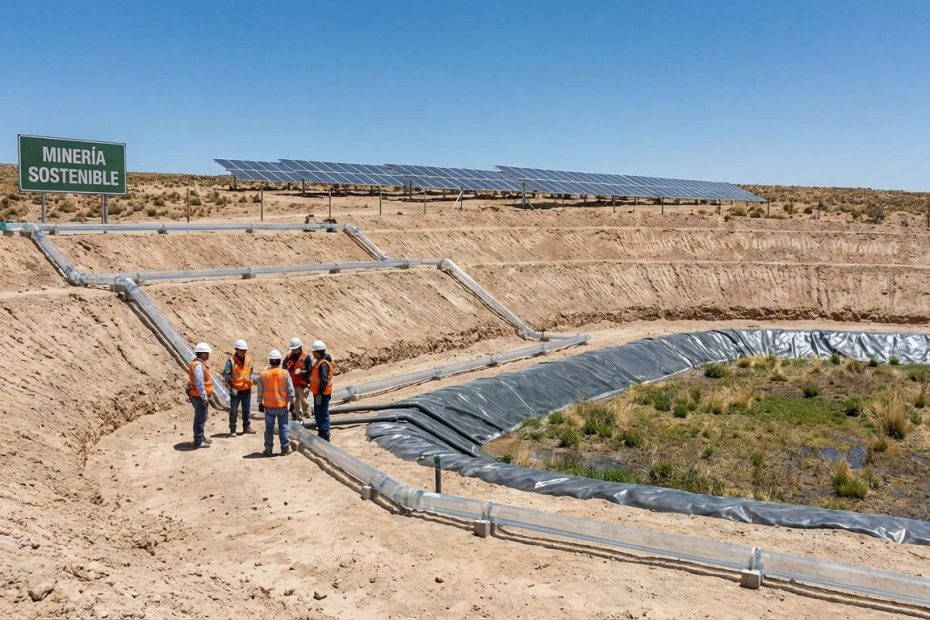
Sustainable mining in South America now works as a business requirement, not a public relations layer. If you run, finance, supply, insure, or evaluate mining assets in the region, profitability depends on how well you manage water, energy, tailings, permitting, community trust, and security at the same time.
You are dealing with a mining market shaped by copper, lithium, iron ore, gold, and transition-mineral demand, yet returns no longer rest on grade and volume alone. The companies that keep operating margins intact are the ones that cut freshwater dependence, lock in cleaner power, tighten dam governance, and reduce the disruption risk that comes from social conflict and weak execution. This article gives you a practical reading of where South American mining stands, what separates durable assets from fragile ones, and what actions matter if you want environmental responsibility to support long-term value instead of eroding it.
What Does Sustainable Mining In South America Actually Mean Today?
If you work in mining, you already know sustainability is no longer a side report prepared for investors after the operating plan is set. In South America, sustainable mining means designing production around environmental, social, and governance performance from the start. That includes water stewardship, lower-emissions power supply, stronger tailings controls, cleaner transport and processing, community engagement, worker safety, traceability, and realistic closure planning.
You also need to separate slogans from operating reality. A mine is not sustainable because it uses the term in a presentation or buys renewable electricity certificates. It becomes sustainable when you can show that the asset remains financeable, permitted, insurable, and socially accepted under tighter water constraints, stricter waste controls, and closer public scrutiny. That standard is much harder, and it is becoming the one that matters.
South America gives this issue unusual weight because the region sits near the center of global supply for copper, lithium, iron ore, silver, and other minerals linked to electrification and industrial production. Chile and Peru matter for copper, Chile and Argentina matter for lithium, Brazil matters for iron ore and broader mining scale, and several Andean jurisdictions carry high untapped resource value. When those countries tighten expectations around water use, emissions, tailings, consultation, or local benefit-sharing, the effects move through global supply chains.
You can also see that sustainable mining in this region is no longer defined only by legal compliance. Investors, lenders, customers, insurers, governments, and communities are testing whether a mine can absorb environmental costs without breaking project economics. That is why environmental, social, and governance performance has moved from reporting language into cost of capital, permit timelines, procurement contracts, and valuation models.
The practical meaning is simple: you need an operating model that protects resource access and protects margins at the same time. If your mine can lower energy volatility through renewable contracts, reduce water conflict through desalination or seawater systems, and avoid shutdowns tied to weak engagement or unsafe waste storage, your environmental program starts functioning like a profitability program. That is where the conversation has moved.
Can Mining Companies In South America Stay Profitable While Meeting Environmental, Social, And Governance Goals?
Yes, they can, but only if you treat environmental, social, and governance goals as operating discipline instead of extra cost. The old model treated environmental safeguards and community engagement as friction added to a project after the feasibility case was built. That model is failing across South America because the unpriced risks, water restrictions, permit delays, local opposition, litigation, illegal mining pressure, and infrastructure gaps, now hit earnings with enough force to erase any short-term savings.
If you want profitability to hold, you need to push environmental risk reduction into mine planning, power procurement, logistics, and capital allocation. Renewable energy contracts can cut long-run exposure to volatile fuel inputs. Desalination or seawater systems can stabilize operations in arid zones where freshwater access becomes a political and operational flashpoint. Better tailings governance can prevent catastrophic liabilities that destroy value for years. Stronger local agreements can reduce downtime that no production spreadsheet ever prices correctly at the start.
Chile offers one of the clearest operating examples. Large copper producers have moved deeper into renewable electricity procurement, and state-backed and private operators have tied future competitiveness to cleaner power supply. If your cost structure benefits from cleaner and often more predictable electricity over time, environmental performance stops looking like a margin drag and starts looking like supply security.
Peru gives you a second lesson. There, the business case is less about optics and more about continuity. A mine can have strong reserves and sound engineering yet still lose value through conflict, security breakdowns, permit friction, or weak local legitimacy. If community agreements, regional infrastructure, and public-order conditions are unstable, production risk rises and your return profile weakens. That means environmental, social, and governance spending is not just a compliance budget. It is a defense against interruption.
Brazil sharpens the point from another angle. After major tailings failures, the cost of getting waste governance wrong became impossible to ignore. Stronger dam rules, tighter oversight, and legal exposure raised the bar for project bankability. Compliance costs increased, yet the alternative is far worse. When a disaster turns into multiyear liability across jurisdictions, the true cost sits far above any prevention budget.
If you are measuring whether profitability and responsibility can coexist, do not ask whether cleaner power, water systems, or community engagement add expense. Ask whether the mine can survive without them. In many South American jurisdictions, that is now the more serious financial question.
Why Is Water The Biggest Environmental Pressure Point For Mining In Chile, Peru, And Argentina?
Water sits at the center of mining risk in much of South America because major mineral deposits overlap with arid regions, fragile ecosystems, agricultural demand, and communities that already distrust extractive development. If you operate in northern Chile, the Atacama zone, parts of Peru, or lithium-producing areas tied to salt flats and groundwater systems, water is not a technical subtopic. It is one of the main forces shaping permit speed, capital intensity, community acceptance, and long-run output stability.
You need to recognize why water dominates investor and community scrutiny. Water is visible. People can see local scarcity, competition over shared resources, and the uneven distribution of costs and benefits. A company can speak about decarbonization targets and cleaner power, yet local resistance will remain if surrounding communities believe mining still absorbs scarce water or shifts environmental damage from one place to another. In practical terms, water is where environmental performance becomes real to the public.
Chile has moved furthest toward replacing continental freshwater with seawater and desalination in copper mining. That shift is strategically important because many high-value operations sit near severe water stress. If you can use desalinated water or direct seawater systems, you reduce dependence on inland freshwater basins and protect operating continuity. Yet this is not a simple fix. Desalination plants, pumping systems, pipelines, and associated energy demand require large capital outlays, long development windows, and strong infrastructure execution.
You also need to measure second-order effects. Desalination lowers pressure on some freshwater sources, but it creates coastal infrastructure impacts, power demand, and new community concerns around marine effects and project footprint. That means your water plan cannot stop at engineering. You need permitting discipline, route planning, stakeholder engagement, and transparent reporting on actual water balances.
Peru faces a different but related pressure. Water disputes often connect to broader frustration over land, revenue distribution, public services, and trust in government enforcement. In many mining zones, conflict does not begin with a technical debate about hydrology. It begins when communities believe they carry environmental risk without seeing clear and durable local gains. You need a water strategy that speaks to social legitimacy, not just throughput and treatment standards.
Argentina’s lithium-producing regions push the water issue into another form. Brine extraction and salars raise concerns around hydrological balance, ecosystem effects, and the rights of local and Indigenous communities. If you are evaluating lithium assets, you cannot treat water as a generic sustainability item copied from a copper template. Extraction method, basin conditions, and monitoring quality change the risk profile in material ways.
The companies that handle water well in South America do three things better than the rest. They redesign supply early, they invest before scarcity turns into a shutdown, and they communicate with enough specificity that communities can test what is being promised. If you miss any one of those, your water issue can become an earnings issue very quickly.
Is Chile Leading Sustainable Mining In South America?
Chile is leading in several of the most measurable parts of sustainable mining, especially mining decarbonization, renewable electricity adoption, and the industrial shift toward seawater and desalination. If you want to see where large-scale environmental transition is furthest along in regional mining, Chile is the reference point. It combines large copper production, policy direction, utility-scale renewable capacity, technical depth, and major company investment in cleaner operating systems.
You can see that leadership in power procurement. Chilean mining has moved far into renewable electricity use, and major producers have tied their medium-term competitiveness to cleaner grids and long-term supply contracts. This matters operationally because power is a major input cost, and cleaner electricity can improve both emissions performance and supply predictability. When state-owned and private operators move in that direction at scale, the pattern is not symbolic. It changes the economics of mining.
You can also see it in policy ambition. Chile has set a carbon-neutral goal for mining and has backed that direction with system-level changes rather than isolated pilot projects. Major mining companies have made public commitments tied to cleaner electricity matrices and reduced operational emissions. If you are comparing jurisdictions, Chile offers the strongest combination of resource scale and visible transition effort.
Water transition is another reason Chile stands out. Copper operators have invested in desalination, seawater transport, and reduced freshwater extraction because water scarcity leaves them little alternative. This has turned environmental pressure into engineering and capital planning at a national scale. Few mining countries have had to adapt as quickly or as visibly on this front.
Still, leadership does not mean public trust is settled. Communities continue to question whether large infrastructure systems solve local problems or simply move them. Technical progress can outpace social legitimacy, especially in regions where historic extraction left scars or where residents see mining wealth flowing outward faster than public benefit flows inward. If you are using Chile as a model, remember that strong operating metrics do not guarantee social acceptance.
The practical lesson is useful. Chile shows you what sustainable mining looks like when energy, policy, and capital align. It also shows that no amount of engineering exempts a company from proving fairness, transparency, and local value. If your company copies the hardware and ignores the social dimension, you will copy only half the model.
What Are The Biggest Environmental, Social, And Governance Risks For Mining In Peru Right Now?
Peru remains one of the most important mining countries in the world, especially for copper, yet its risk profile is shaped as much by governance and social stability as by geology. If you are investing, operating, lending, or supplying into Peru, the main environmental, social, and governance risks run through social conflict, illegal mining, security threats, permitting friction, uneven state capacity, and the persistent gap between mining wealth and local development outcomes.
Social conflict remains central because many disputes around mining are not isolated environmental complaints. They combine water concerns, land use, employment expectations, public service failures, and distrust built over years. If communities believe a project will strain local resources without improving roads, schools, health care, jobs, or business opportunities, resistance can harden fast. That puts production continuity at risk even when the geology is strong and the engineering case is sound.
Illegal mining adds a second layer of pressure. It damages ecosystems, fuels insecurity, weakens state control, distorts local economies, and complicates the public image of the broader mining sector. For formal operators, this matters even when illegal activity sits outside their concession boundaries. It can alter security conditions, labor markets, transportation routes, and community expectations. It also widens environmental, social, and governance risk beyond environmental performance into rule of law and worker safety.
Security concerns have become harder to dismiss. Violent incidents tied to mining regions have highlighted how fragile operating conditions can become when criminal networks, informal extraction, and weak enforcement overlap. If a project sits in a zone where public-order conditions deteriorate, your risk register changes immediately. Insurance, staffing, logistics, and contractor oversight all become more complex and more expensive.
At the same time, Peru still offers strong upside for operators that execute well. Large-scale copper assets, strong export relevance, and growing pressure for transition-mineral supply keep Peru central to global mining strategy. The point is not that Peru is too risky to mine. The point is that success depends on building a mine that can withstand local political and social pressure, not just one that can hit technical production targets.
If you are planning in Peru, your operating model needs stronger community agreements, better grievance handling, tighter contractor control, stronger security governance, and a clear local development case that people can verify. Without that, environmental, social, and governance risk remains abstract only on paper. On the ground, it becomes delay, blockade, stoppage, and margin erosion.
How Is Brazil Changing Mining Standards After Tailings Disasters?
Brazil has become the clearest example of how catastrophe can rewrite mining standards. After devastating tailings dam failures, the country tightened rules around dam safety, oversight, waste management, and accountability. If you operate in Brazil or benchmark your systems against global best practice, you need to understand that tailings governance is no longer an engineering specialty handled in the background. It is a board-level issue with legal, financial, operational, and reputational consequences.
The shift matters because tailings failures destroy more than infrastructure. They can kill people, contaminate river systems, cripple communities, trigger years of litigation, and wipe out trust in the sector. When that happens, the costs are not temporary and they are not limited to one site. They move across parent companies, investors, insurers, contractors, regulators, and courts, often across borders. That is why Brazil’s regulatory changes carry weight beyond Brazil itself.
You can see the new standard in stricter dam oversight and stronger expectations around waste handling and reuse. This pushes companies to spend more upfront on monitoring, engineering assurance, emergency planning, decharacterization where required, and stronger governance around old structures. Those costs are real, but they are part of the operating threshold for a mine that expects to remain fundable and insurable.
Brazil also matters as a legal warning. Tailings-related liability has proven long-lived, expensive, and reputationally destructive. If you are still treating tailings management as a compliance line item, Brazil shows why that thinking fails. The real financial exposure emerges years later, after court actions, compensation disputes, remediation obligations, and public scrutiny compound the damage.
This is where environmental responsibility and profitability meet in very direct terms. Stronger tailings governance raises costs in the near term, yet it also protects your balance sheet from the type of loss event that can impair a company for a decade or longer. In mining, that is not optional discipline. It is survival discipline.
The broader message for South America is clear. Tailings safety is no longer judged by whether a company meets its own internal standard. It is judged by whether failure is structurally prevented, independently tested, and governed with enough seriousness that investors, regulators, and communities can trust the system before something goes wrong.
What Do Communities Actually Expect From Sustainable Mining In South America?
Communities usually judge sustainable mining by outcomes they can see and measure. They want to know whether water remains available, rivers stay clean, roads improve, local businesses gain work, jobs go to local people, emergency response is real, and promises survive beyond the permit phase. If your company speaks in broad environmental, social, and governance language but cannot answer those practical questions with specifics, trust weakens.
You should also recognize that community expectations are not limited to environmental protection. In mining districts across South America, residents often connect environmental risk to fairness. They ask who absorbs the burden, who captures the revenue, who gets consulted before decisions are made, and who benefits once production starts. If the answer appears one-sided, opposition grows even where a company meets technical standards.
This is why the phrase social license to operate still matters. It may sound overused in corporate language, yet on the ground it describes something very concrete: whether people tolerate, support, or resist your presence. Mines rarely lose public support over one issue alone. Support erodes when companies underperform repeatedly on communication, water management, local procurement, employment quality, land access, or grievance response.
You also need to understand that communities compare formal mining with illegal or informal activity in complicated ways. In some areas, people resent illegal mining because it fuels contamination, violence, and instability. In others, informal extraction may still provide income where the formal economy does not. That means a formal operator cannot assume community support simply by being more regulated. You still need to show a tangible economic and environmental advantage.
The strongest operators usually earn more trust by being specific and measurable. They publish water-use data in understandable terms, define local hiring targets, explain supply-chain opportunities clearly, maintain visible complaint channels, and follow through when problems emerge. Communities do not expect perfection. They expect seriousness, consistency, and proof.
If you want sustainable mining to mean something outside the corporate office, connect it to operating decisions people can verify. That is when environmental, social, and governance language starts turning into operating legitimacy.
What Practical Moves Separate Strong Sustainable Mining Operators From Weak Ones?
If you want to know which mining companies are positioned to protect value in South America, look at what they implement before pressure becomes a crisis. Strong operators secure renewable electricity over the long term, redesign water sourcing early, audit tailings systems rigorously, build local procurement and employment channels, and maintain direct community engagement long before permit trouble surfaces. Weak operators wait until conflict, drought, or scrutiny forces rushed spending.
You should also watch capital discipline. Sustainable mining is not about spending more on every possible initiative. It is about spending on the risks most likely to stop production, raise financing costs, or trigger legal exposure. In northern Chile, that often means water and energy. In Peru, that can mean community agreements, security governance, and local benefit-sharing. In Brazil, tailings and waste governance command more weight. Geography changes the priority list.
Data quality matters as much as engineering quality. If management cannot produce reliable numbers on water intensity, emissions intensity, waste handling, incident trends, local procurement, and grievance resolution, you are not looking at a mature environmental, social, and governance system. You are looking at a reporting gap that may hide an operating gap. Investors and lenders increasingly read those gaps as warning signs.
Another separator is contract structure. Companies that secure cleaner power, long-term water infrastructure, and resilient logistics put themselves in a stronger position when commodity prices soften or public scrutiny rises. Those contracts do more than support environmental targets. They protect uptime and planning certainty. That is exactly where value is defended in a volatile mining cycle.
You should also test whether leadership links environmental, social, and governance goals to compensation, capital approval, and mine planning. If sustainability sits outside the decisions that govern expansion, procurement, scheduling, and closure liability, it remains cosmetic. Strong operators embed it in the same rooms where production, cost, and growth are decided.
The market is moving toward a simple test. Can this asset produce reliably under tighter environmental limits and stronger social expectations? The companies that answer yes are not just better branded. They are better built.
How Can Mining In South America Balance Profitability And Environmental Responsibility?
- Cut freshwater use through seawater, recycling, and desalination where viable.
- Lock in renewable electricity to lower emissions and power risk.
- Strengthen tailings safety, community agreements, and local benefit-sharing.
- Reduce shutdown risk, legal exposure, and financing pressure.
Build Mines That Stay Operable, Financeable, And Trusted
If you work in South American mining, the path forward is straightforward: build operations that can keep running under tighter environmental limits, stronger public scrutiny, and harder capital tests. Profitability now depends on reducing water stress, securing cleaner power, strengthening tailings governance, and earning community trust with visible results rather than promises. Chile shows how scale, power markets, and policy can move mining toward lower-emissions production, Peru shows how social conflict and security can override technical strength, and Brazil shows the cost of getting waste governance wrong. The winners in this market will be the operators that treat environmental responsibility as part of production strategy, not as a report filed after the fact. If you want assets that hold value through volatility, build them to survive the real pressures already shaping South American mining.
References
- Center on Global Energy Policy at Columbia University School of International and Public Affairs: Roundtable Report on Environmental, Social, and Governance Challenges in Latin America’s Mining Sector
- Organisation for Economic Co-operation and Development: Supporting the Green Transition, Peru
- Organisation for Economic Co-operation and Development: Economic Survey of Chile
- Organisation for Economic Co-operation and Development: Achieving a Green Transition for a More Prosperous Chile
- Corporación Nacional del Cobre de Chile: Renewable Electricity Supply Contracts
- Water. Desalination and Reuse: Chile’s Copper Mines and Desalination
- Anglo American: Desalinated Water Supply for Los Bronces
- The Guardian: Water and Mining Pressure in Chile’s Atacama Region
- Defensoría del Pueblo del Perú: Social Conflicts Report
- Associated Press: Killings Linked to a Peruvian Gold Mine
- Chambers and Partners: Mining in Brazil, Trends and Developments
- Associated Press: Legal Liability Linked to Brazil’s Major Environmental Disaster
- Business and Human Rights Resource Centre: Transition Minerals Tracker
- Anglo American: Quellaveco Mine Overview

Alex Clug is a global entrepreneur and investor with 25+ years building and scaling ventures in medical robotics, telecommunications, mining, and private equity. He currently leads The Dolphin Group, advising early-stage and cross-border companies in robotics, fintech, natural resources, and other innovation-driven industries.