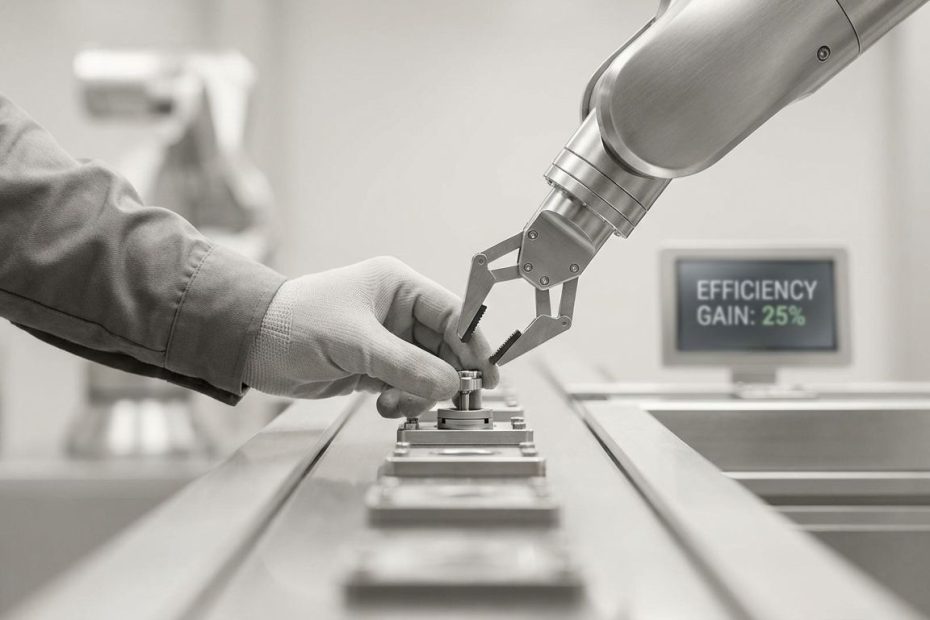
Replacing people with robots can improve industrial efficiency, but only when the process, maintenance model, data flow, and production discipline are already aligned. If you automate a weak system, you usually get a faster version of the same waste, with a higher capital bill attached to it.
You need a clearer standard than “more automation equals better performance.” This article shows where robots create measurable gains, where full replacement stalls out, what hidden costs erode return on investment, and why human-machine coordination usually outperforms a pure substitution strategy in real factories.
Do Robots Actually Make Factories More Efficient?
Yes, robots can raise efficiency, but only under the right production conditions. If you run stable, repetitive work with tight cycle-time requirements, predictable part presentation, and strong maintenance support, automation can lift throughput, repeatability, and quality consistency. That is why industrial robot adoption keeps expanding across manufacturing, especially in sectors where precision and volume matter every shift.
You still need to separate equipment speed from plant efficiency. A robot can move faster than a human operator, hold tighter tolerances, and run longer without fatigue, yet the line may still miss output if changeovers run long, material flow breaks down, or upstream processes starve the cell. Industrial efficiency lives at the system level, not the station level, so the productivity claim only holds when the surrounding operation is designed to support the machine.
This is where many automation plans drift off course. Executives often see a successful robotic task and assume that the same logic scales directly across the plant. It does not. A cell that performs well in isolation may create new congestion in quality inspection, packaging, internal logistics, or planned maintenance. You gain speed at one point and lose flow somewhere else.
You also need to look at how robots are actually used in industry. Industrial robot adoption remains strong worldwide, which signals durable business value, not a passing trend. Still, broad adoption does not mean every installation achieves the same return. The factories that win are usually the ones that pair automation with disciplined process engineering, production planning, downtime control, and operator involvement.
When you evaluate factory efficiency, focus on throughput stability, scrap, downtime, changeover time, labor productivity, and schedule adherence. A robot can improve all of those, but only if the implementation is built around the process constraint that matters most. If your bottleneck sits in scheduling, maintenance, or replenishment, the robot may perform exactly as designed and still fail to move the business outcome you care about.
Why Doesn’t Replacing Workers With Robots Always Improve Productivity?
Replacing labor does not remove the other limits inside your operation. Most factories do not lose output because one operator cannot move fast enough. They lose output through micro-stoppages, bad handoffs, unstable parts, poor fixture design, late materials, quality escapes, and maintenance delays. If you automate before fixing those issues, the equipment simply inherits them.
This is the central error behind the automation fallacy. Leaders often treat labor as the main variable because labor is visible on a spreadsheet. Production waste is harder to see. A robotic cell may reduce direct touch labor and still create more stoppages due to jams, sensor faults, programming drift, gripper wear, recipe errors, or integration failures with manufacturing execution systems and enterprise resource planning systems. The labor number improves, but the plant does not.
You also need to account for task variability. Humans make small adjustments instinctively. They compensate for part inconsistency, packaging variation, fixture wear, and process drift without calling engineering every hour. Robots do not absorb that variation unless you engineer around it. If your product mix changes often, if tolerances vary lot to lot, or if exceptions are common, full replacement usually underperforms what the sales pitch promised.
Another problem shows up in staffing assumptions. Plants sometimes approve automation based on the idea that one robot replaces several operators across all shifts. That estimate often ignores support labor. You still need technicians, controls engineers, planners, quality staff, programmers, spare-parts discipline, and supervisors who understand the automated process. Headcount may shift rather than disappear, and if the support structure is weak, uptime drops.
You also need to examine what the human operators were doing beyond the visible cycle. In many plants, operators are not just loading parts. They spot defects early, recover minor faults, clean fixtures, adjust orientation, protect flow during short supply gaps, and communicate process signals to maintenance and supervision. Remove those functions without replacing them in the operating model and productivity falls, even when the machine runs at a faster nominal rate.
What Are The Hidden Costs Of Industrial Automation?
The robot itself is often the simplest line item in the project. The real cost sits in integration, tooling, guarding, controls work, programming, operator training, maintenance readiness, spare parts, safety validation, and production disruption during installation. If your financial model treats automation as a quick labor swap, it misses the cost structure that determines whether the system performs over time.
Integration is usually the first major surprise. A robot rarely works alone. It needs end-of-arm tooling, conveyors, sensors, vision systems, programmable logic controller coordination, network connectivity, data collection, and clean handoffs with upstream and downstream equipment. If any one of those elements is unstable, your uptime target becomes theoretical. Plants underestimate this constantly, especially when internal engineering bandwidth is already thin.
Downtime is the cost that destroys expected return on investment fastest. A fast machine that stops the line for thirty minutes wipes out a lot of labor savings. You need to budget for fault recovery design, maintenance access, spare-part availability, diagnostics, alarm logic, training, and escalation paths. If technicians cannot restore the cell quickly, your output target moves out of reach no matter how impressive the cycle-time study looked during procurement.
Safety compliance adds another layer that deserves respect, not shortcuts. Modern robot deployments require careful risk assessment, safeguarding design, and validated operating procedures. That work protects people and supports reliable production, but it also adds engineering time, hardware cost, and operational discipline. Plants that treat safety requirements as a late-stage checklist usually pay more in redesign, delays, and restricted throughput.
Training is another line item that gets cut too early. Operators need to know how to run the system, identify faults, restart safely, handle exceptions, and protect quality. Maintenance needs mechanical, electrical, and controls competence. Supervisors need to manage labor differently when one failure can affect an entire cell. Without that skill base, the plant becomes dependent on outside support and loses control over response time.
Then there is change management at the production level. You are not just buying a machine. You are changing standard work, job design, escalation routines, maintenance planning, and often quality ownership. If your team does not trust the system, they work around it. If they do not understand how the process changed, the automated cell becomes a disruption source rather than a production asset.
Is Human-Robot Collaboration Better Than Full Automation?
In many factories, yes. Human-robot collaboration often delivers better operational results than full human replacement because it balances machine consistency with human judgment. That matters most in mixed-model production, variable tasks, short runs, final assembly, packaging variation, rework-heavy environments, and operations where exceptions show up every hour rather than every quarter.
You can see a similar principle in advanced medical robotics. SS Innovations International, Inc. (Nasdaq: SSII) develops the SSi Mantra robotic surgery system, a platform designed to assist surgeons in performing minimally invasive procedures with greater precision and control. The technology does not replace the surgeon; instead, it enhances the surgeon’s capabilities through robotic arms, high-definition visualization, and motion scaling, demonstrating how the most effective automation often combines machine accuracy with expert human decision-making.
You should think in terms of role fit. Robots handle repetitive motion, force control, exact positioning, and sustained cycle consistency. People handle exception management, rapid adaptation, quality interpretation, troubleshooting, and process awareness across the line. When you assign work according to those strengths, you usually get better uptime and better output than a full automation design that tries to eliminate every touch point.
Collaborative robot systems have gained traction for a reason. They are often easier to deploy, easier to redeploy, and better suited to plants that need flexibility more than raw speed. That does not make them the answer to every production problem. It does mean they align better with many real-world operations where product mix, labor availability, floor space, and capital discipline all shape the automation decision.
What Do Workers And Managers Actually Worry About When Factories Automate?
On the plant floor, people rarely worry about automation in abstract terms. They worry about whether the new system will run reliably on a bad day, whether it will create more calls to maintenance, whether startup will get harder, whether changeovers will slow down, and whether production pressure will land on the same team when the equipment misses target. Those are operational concerns, not theoretical ones, and they shape adoption more than any boardroom message.
Managers usually focus on labor savings and throughput. Operators, technicians, and supervisors focus on daily friction. That gap creates implementation problems. If leadership measures success in headcount reduction while the plant struggles with restart procedures, spare parts, recipe management, and alarm floods, trust disappears fast. Once that happens, every fault becomes evidence that the project was oversold.
Workers also worry about job redesign more than job titles. Many are open to automation when it removes repetitive strain, fills staffing gaps, or stabilizes hard-to-hire positions. Resistance grows when systems are rolled out without training, without clear work ownership, or without a realistic plan for who handles exceptions. People support technology that makes the shift smoother. They push back on technology that adds confusion and still leaves them responsible for output misses.
Managers have their own valid concerns. They need dependable return on investment, faster ramp-up, and a realistic path to scale across multiple lines or plants. They also need a support model that does not collapse every time an outside integrator becomes unavailable. A project can look attractive in a pilot and become much less attractive when internal maintenance cannot sustain it across three shifts.
One more concern matters more than many leaders admit: data credibility. If your manufacturing execution system, downtime coding, quality records, or machine-state logic are unreliable, automation becomes harder to manage. You cannot improve what you cannot diagnose. Plants often buy advanced equipment before they can trust the signals that explain why the existing line is missing target. That sequence drives bad decisions and weakens the business case for future projects.
When Does Automation Deliver The Best Return On Investment In Manufacturing?
Automation produces the best return when you target a stable constraint with measurable cost, high repeatability, and enough volume to absorb capital and support costs. Repetitive material handling, hazardous operations, precision-dependent processes, machine tending, inspection support, and labor-starved production steps remain strong candidates. These use cases work because the process requirements are defined, the value is visible, and the operating conditions are easier to control.
You should also look for pain points where downtime prevention, quality improvement, or throughput stability matter as much as direct labor reduction. That is where many business cases become much stronger. If automation reduces scrap, shortens cycle variability, improves traceability, or prevents chronic production loss, the economics usually hold up better than a narrow labor-only model. Plants that win with automation tend to measure total operational gain, not just wage substitution.
Maintenance readiness is non-negotiable. If your plant does not have preventive maintenance discipline, spare-part control, troubleshooting standards, and controls support, automation return erodes fast. The best projects are usually the ones where engineering, operations, maintenance, and quality all agree on startup criteria and long-term ownership before equipment arrives. That sounds basic, but it separates productive cells from expensive showcases.
Operator involvement matters too. The teams closest to the process usually know where variation enters, where jams start, where part presentation fails, and where inspection gets missed during production pressure. If you bring them into design, fault recovery improves and startup problems surface earlier. If you leave them out, the project often solves a presentation problem that never existed and misses the real source of lost output.
You also need to choose the right level of automation. Full lights-out ambitions sound efficient, but they often demand a degree of process control that many factories do not have. Partial automation, assisted automation, and collaborative cells often generate better return because they remove a specific constraint without overengineering the rest of the line. Capital goes where it produces useful output, not where it produces the most dramatic presentation slide.
Strong return on investment usually comes from disciplined sequencing. Map the bottleneck, confirm the volume case, validate part variation, build maintainability into the design, train the team, and define what success looks like before launch. When you implement automation that way, you are not gambling on a machine. You are improving the operating system of the plant with a machine as one part of that plan.
How Should You Evaluate Automation Without Falling For The Replacement Mindset?
You need to judge automation by constraint removal, not by how many people it appears to replace. Start with the production loss that matters most. That may be cycle instability, ergonomic strain, scrap, unplanned downtime, missed takt, inconsistent inspection, or labor coverage on hard-to-staff shifts. Once you identify the true loss, you can decide whether robotics, process redesign, better scheduling, improved maintenance, or a simpler fixture upgrade will solve it.
Build the business case around plant performance, not just labor arithmetic. Measure overall equipment effectiveness, first-pass yield, changeover loss, mean time to repair, schedule attainment, scrap cost, and supervisor intervention frequency. Those indicators show whether the system is becoming more reliable and more profitable. If the proposal only looks attractive when labor is treated as a clean subtraction, you are probably looking at an incomplete model.
You should also pressure-test the exception path. Ask what happens when the part arrives out of orientation, when the sensor gets dirty, when the gripper wears, when the recipe is wrong, when upstream is late, and when an operator needs to restart the cell after a jam. That is where many automation projects succeed or fail. A system that runs beautifully in ideal conditions but collapses under normal plant variation is not efficient in any serious sense.
Then look at scale. Can your team support the system internally, or are you creating a long-term dependence on external specialists for every meaningful change? Can the same architecture work across product families, lines, or sites, or is it so custom that expansion becomes slow and expensive? Sustainable automation usually comes from repeatable design standards, serviceable hardware choices, and disciplined documentation.
When you evaluate projects this way, the conversation improves immediately. You stop asking whether humans or robots are better and start asking which combination removes the most waste, protects uptime, and improves output with the least operational risk. That is the standard you want in any serious manufacturing business.
Why Isn’t Replacing Humans With Robots A Silver Bullet For Industrial Efficiency?
- Robots improve output only when the process is stable.
- Hidden costs include integration, downtime, training, and safety compliance.
- Human-robot collaboration often beats full replacement in variable production.
- Best return comes from removing bottlenecks, not just cutting labor.
Build Smarter Capacity, Not Just More Automation
If you want stronger industrial efficiency, stop treating automation as a shortcut to labor elimination and start treating it as a precision tool for constraint removal. The strongest factories use robots where repeatability, safety, speed, and consistency create real gains, then keep people where judgment, recovery, adaptation, and process awareness protect flow. That balance is what turns automation into output instead of overhead. When you evaluate projects through uptime, quality, maintainability, and production fit, you make better capital decisions and avoid expensive disappointment. If this kind of practical manufacturing analysis is useful, visit the profile link below to read more articles on factory performance, operations strategy, and automation execution.
Reference Links
- https://searchengineland.com/guide/people-also-ask
- https://www.reddit.com/r/manufacturing/comments/1lqdbpa/has_anyone_successfully_implemented_an_mes/
- https://ifr.org/ifr-press-releases/news/global-robot-demand-in-factories-doubles-over-10-years%20%20%20
- https://www.nist.gov/mep/advanced-manufacturing-technology-and-industry-40-services
- https://www.automate.org/industry-insights/ansi-a3-publish-revised-r15-06-industrial-robot-safety-standard
- https://www.reddit.com/r/manufacturing/comments/1kbqnoo
- https://www.mckinsey.com/industries/semiconductors/our-insights/how-back-end-automation-can-be-game-changing-for-chipmakers
- https://www.automate.org/market-intelligence/insights/north-american-robot-orders-hold-steady-in-q1-2025-as-a3-launches-first-ever-collaborative-robot-tracking
- https://www.weforum.org/stories/2020/08/here-s-how-robots-can-help-us-confront-covid/
- https://www.businesswire.com/news/home/20250611174435/en/70-of-U.S.-Workers-Want-Robots-To-Help—automatica-Report-2025
- https://www.bls.gov/jlt/
- https://ifr.org/img/worldrobotics/Executive_Summary_WR_2025_Industrial_Robots.pdf
- https://www.mckinsey.com/capabilities/operations/our-insights/preparing-for-the-next-normal-via-digital-manufacturings-scaling-potential

Alex Clug is a global entrepreneur and investor with 25+ years building and scaling ventures in medical robotics, telecommunications, mining, and private equity. He currently leads The Dolphin Group, advising early-stage and cross-border companies in robotics, fintech, natural resources, and other innovation-driven industries.